
A Scientist’sGuide toCreativityon Guitar
A Journey into Music Freedom
Other Amazon stores
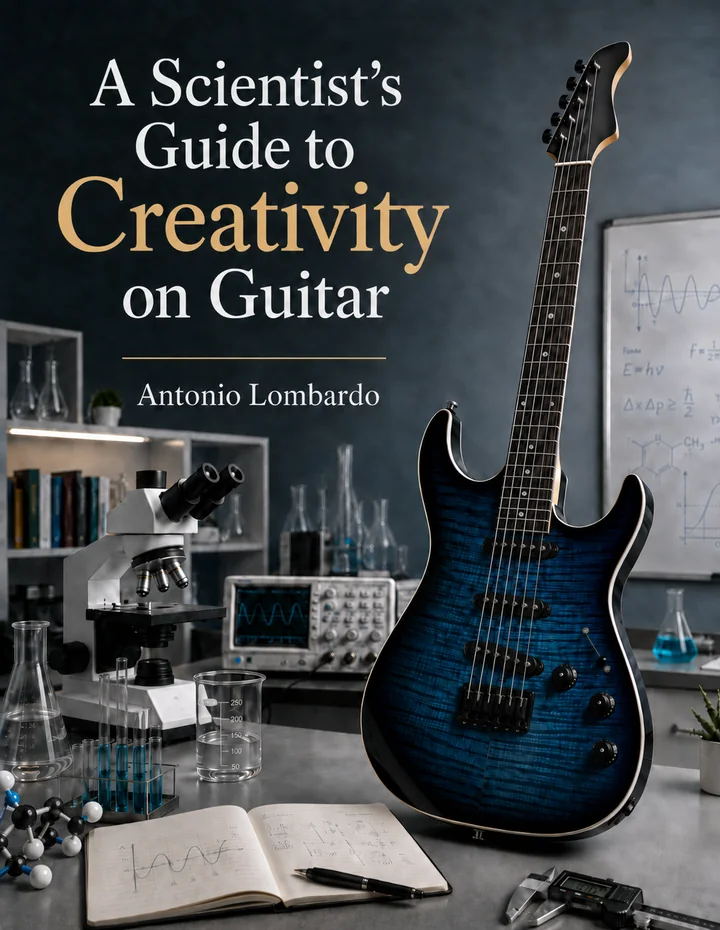
What if you approached improvising and composing on guitar the way a scientist approaches a problem?
Most guitar methods hand you shapes to memorize. This book shows you why those shapes work, and how to use that understanding to play something of your own.
A system, not a set of shapes
The fretboard can be daunting: a two-dimensional landscape where frets repeat endlessly and visual reference points are scarce. Memorizing scale diagrams is the usual response, but it pulls attention away from sound, harmonic function and expressive intent, and leads to repetitive playing.
This book treats the guitar as a system to be understood. Scales are broken down into a small set of “building blocks” defined by scale degrees. They let you build any scale in any key, anywhere on the neck, while knowing the function of every note you play.
Who it is for
Intermediate guitarists who have basic technique and theory, feel limited by pattern-based playing, and want a deeper, more flexible understanding of the instrument.
Inside the book
Chapters 1 and 2
How the fretboard works
A concise introduction to essential theory, then clear rules for finding any note anywhere on the neck, including how to handle the tuning irregularity between the third and second strings.
Chapters 3 to 5
Scales from building blocks
The minor pentatonic scale, the backbone of blues and rock, is broken into five blocks, each defined by the degree of its notes. The same blocks then extend to the natural minor, major pentatonic and major scales, revealing a single structure behind all of them.
Chapter 6
Harmony from scales
Chords are not treated as a separate world. They are built directly from the scales you have just learned: harmonizing a scale shows where each chord comes from and which notes fit over it, so that your chords and your lines work together.
Chapter 7
The Circle of Fifths as a musical compass
A practical tool for navigating keys, harmonizing scales, modulating and supporting improvisation.
Chapter 8
Modes made simple
A function-based view of a topic often considered difficult and confusing.
Chapter 9
Learning from the masters
The Circle of Fifths and degree-based scales are used to analyse songs and show how great composers and improvisers choose notes and techniques to reach an expressive goal. You take away ideas to use in your own playing, not solos to copy.
On this site
Free material to use alongside the book.
About the author
Antonio Lombardo is Associate Professor of Nanostructures and Devices at University College London, where he leads the Nanoelectronic Devices research group. He combines nearly 20 years of experience as a scientist and educator with over 25 years as a guitarist.
Where the profits go
All profits from this book go to Cancer Research UK and Addenbrooke’s Charitable Trust.
A Scientist’s Guide to Creativity on Guitar
Paperback, 8.5 × 11 in, by Antonio Lombardo.